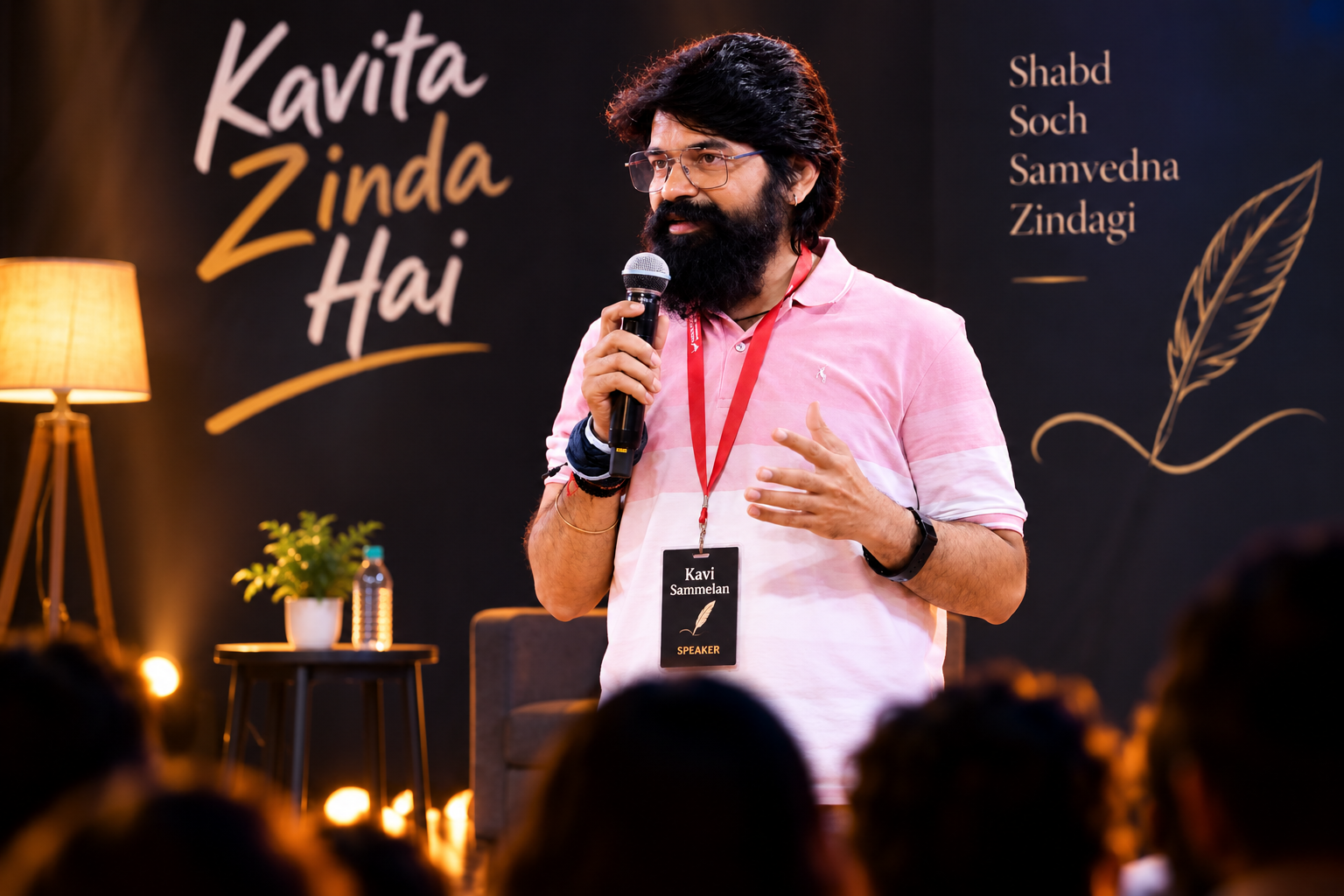
For years, a familiar lament echoed through literary circles: Hindi was losing its young readers. English was the language of ambition, of careers, of the internet; Hindi, the pessimists said, was becoming the language of nostalgia — loved, respected, and quietly abandoned. The mehfils were greying. The literary magazines were thinning. The future of Hindi poetry seemed to belong to the past.
Then something unexpected happened. The same internet that was supposed to bury Hindi literature gave it a second, louder life.
The Mehfil Without Walls
Today, a sher recorded on a phone in a small town can reach a million listeners by morning. Instagram reels and YouTube have become the new mehfil — a gathering without walls, without gatekeepers, without the old barriers of geography and access. A teenager in Patna and a software engineer in Bengaluru can hear the same nazm in the same minute and respond to it in the same comment section. The intimacy of the mehfil has been preserved while its reach has exploded beyond anything the old masters could have imagined.
This is not a dilution of the tradition. It is its democratisation. For decades, access to serious poetry was filtered through a handful of institutions, publishers and established platforms. Today, a young poet needs only a phone and a voice. The audience — not an editorial board — decides whose words resonate. The result has been an explosion of new voices: poets from small towns, women poets, poets writing in dialects and regional inflections that the old gatekeepers rarely platformed.
Why the Young Are Returning to Hindi
The revival is driven by something deeper than technology — it is driven by hunger. A generation raised in English-medium classrooms and globalised feeds is discovering a gap that English content cannot fill: the language of home. Hindi carries the vocabulary of their grandmothers, their streets, their interior emotional lives. When a young person hears a sher that names a feeling they could never articulate in English, something clicks. The language they were taught to leave behind turns out to be the language of their deepest self.
Short-form video, so often blamed for shortening attention spans, has paradoxically become poetry's greatest ally. A sher is, after all, the original short-form content — a complete emotional world compressed into two lines. The format that rewards brevity and emotional punch is perfectly suited to the couplet. Poets have learned to treat the reel not as a compromise but as a craft: the visual, the pause, the background music, all composed to serve the line.
The New Ecosystem
The revival is not only online. Open mics and poetry collectives have multiplied across Indian cities, creating physical spaces where the digital community gathers in person. College festivals now book poets alongside musicians and comedians. Brands and filmmakers seek out shayars for campaigns and soundtracks. Publishing has been forced to adapt, with poets building audiences first and negotiating from strength rather than pleading for a platform.
This ecosystem has also created new paths to livelihood — performance fees, brand collaborations, content licensing, workshops and merchandise — allowing talented poets to pursue the craft professionally in a way that was nearly impossible a generation ago. Poetry is no longer only a passion subsidised by a day job; for a growing number, it is a viable creative career.
The Challenges That Remain
None of this is without friction. The same algorithm that amplifies a moving sher also rewards the sensational and the shallow. Quality can be drowned by volume, and the pressure to post constantly can tempt poets toward quantity over craft. There is also the danger of the echo chamber — poetry optimised for likes rather than for truth, verses engineered to perform rather than to mean.
The serious poet's task in this environment is to use the platform without being used by it. The feed is a doorway, not a destination. The poet who builds an audience online must still do the old, unglamorous work: reading deeply, revising ruthlessly, performing honestly. The technology has changed the distribution; it has not changed what makes a poem worth hearing.
The Economics of the New Poetry
The digital revival has also quietly rewritten the economics of being a poet. Where once a poet depended on rare publishing deals or the goodwill of event organisers, today's shayar can build a sustainable livelihood through a portfolio of income: live performance fees, brand partnerships, content licensing, online workshops, and even direct audience support. This shift has changed who can afford to be a poet — opening the craft to voices that could never have afforded to pursue it professionally before.
From Performer to Institution
Perhaps the most interesting development is how individual poets are becoming institutions in themselves. A single creator can now operate as writer, performer, publisher and broadcaster simultaneously — releasing poems directly to an audience that the old publishing system would have taken years to reach. This disintermediation has not eliminated quality control; it has relocated it, placing the judgement in the hands of the audience rather than the editor.
What the Tradition Gains — and Risks
The gains are obvious: scale, diversity, immediacy and a global Hindi-speaking audience that was previously unreachable. The risks are subtler — the homogenising pressure of the algorithm, the temptation to write for virality rather than for truth, and the loss of the slow, deep listening that a physical mehfil demands. The poets who will define this era are those who can hold both: the reach of the digital and the depth of the traditional.
The Role of Translation and Bilingualism
Another quiet driver of the revival is the rise of bilingual content — poets who move fluidly between Hindi and English, or who translate classical verses for a younger audience. This bridge-making does not dilute the language; it widens the doorway. A young reader who discovers Ghalib through an English-assisted reel may well go on to read the original — and in doing so, the tradition gains a new generation of readers it might otherwise have lost entirely.
The Classroom and the Feed
Significantly, the revival is reaching back into formal education. Teachers who once struggled to make prescribed poetry feel relevant now find students arriving already loving shayari — having discovered it on their phones. The feed has become an unexpected gateway into the syllabus, turning a chore into a curiosity. When a student recognises a sher from a reel in a textbook, the distance between 'literature' and 'life' collapses.
The Responsibility of the Platform
With reach comes responsibility. The poets thriving in this revival carry a quiet obligation: to honour the tradition even as they modernise its delivery, to credit influences, to maintain quality amid the pressure of quantity, and to remember that the feed is a stage, not a substitute for the craft. The audience's trust — so easily won online — is just as easily lost when the work becomes hollow.
A Living Tradition
What we are witnessing is not the invention of something new but the continuation of something very old. Hindi-Urdu poetry has always been a living, oral, popular tradition — the qawwali, the mushaira, the folk geet were never elite art forms but the people's art. The digital mehfil is simply the latest chapter in that long story of language finding its audience.
The laments about dying languages were premature. Languages do not die when people still need them to say what matters most. As long as a young person falls in love and cannot find the words in any other tongue, Hindi will have its poets. The feed has simply made it easier for those poets to find each other — and for the rest of us to find them.